11 Surprising Medellin Coffee Facts
Short answer. Medellin has 200 registered coffee growers inside its own city limits, one of its farms sits in Comuna 8 and is reached by cable car, and none of it is in the region most visitors mean when they say Colombian coffee.
Colombia is the country everybody associates with coffee and Medellin is the city everybody flies into, and yet almost nothing written in English joins the two up. These are the facts that surprise people on a coffee tours from Medellin, in the order they usually surprise them.
1. The city grows coffee inside its own boundary
The Alcaldía de Medellin counts 200 registered coffee growers across its five corregimientos — the rural districts that are legally part of the city. 120 of them are in San Sebastián de Palmitas alone. Very few large cities anywhere produce commercial coffee within their own limits.
2. Antioquia is the country's number two, not the Coffee Triangle
Antioquia is the second-largest coffee-producing department in Colombia, with 114,312 hectares planted against Huila's 145,759 hectares. The Coffee Triangle everybody pictures is Quindío, Risaralda and Caldas, and it is four to seven hours south of Medellin by road. UNESCO's Coffee Cultural Landscape covers 47 municipalities in Caldas, Quindío, Risaralda and Valle del Cauca and does not include Antioquia at all.
3. There is a working coffee farm in Comuna 8
Casa Finca de La Sierra sits in Barrio La Sierra on the eastern slope, and you reach it by tram and cable car from San Antonio. Three hours there covers picking, processing and drinking what the family grew, without ever leaving Medellin. The urban coffee tour page covers how it works.
Did you know? The Ayacucho tram and the cable line above it were built as public transport for Comuna 8, not for tourism. The coffee farm at the top of them was there first.
4. Colombia harvests twice a year and the second crop has its own name
The mitaca — also called the traviesa — is the smaller second harvest, about six months out from the main one. In Antioquia it runs March or April to June. Farms use the word constantly and almost never explain it.
5. The cherry has to be de-pulped the same day
Leave it and the fruit starts fermenting on its own and the lot is ruined. That single constraint is why every small farm has a de-pulper, why picking happens in the morning, and why the wet mill is always close to the rows rather than in town.
6. What makes a coffee "honey" is sticky, not sweet
Mucilage is the layer of fruit left on the bean after de-pulping, and it looks and feels like honey. Leave some of it on through drying and you get a honey-process coffee; wash it off and you get a washed one; dry the whole cherry and you get a natural. One farm here serves the mucilage back to you as a frappé.
7. Cupping involves slurping, loudly, on purpose
The trade's standard tasting method is a bowl, a spoon and a hard slurp that sprays the coffee across your whole palate. It is done exactly the same way from a smallholding to an exporter's laboratory, and it is what puts a score on a lot. The tastings page explains the ritual.
8. Colombia's crop is measured in 60-kilogram sacks
The country closed 2025 at 13.67 million 60-kilogram sacks. The sack is the unit of the whole trade, and every figure a farm quotes you — production, price, yield — comes back to it.
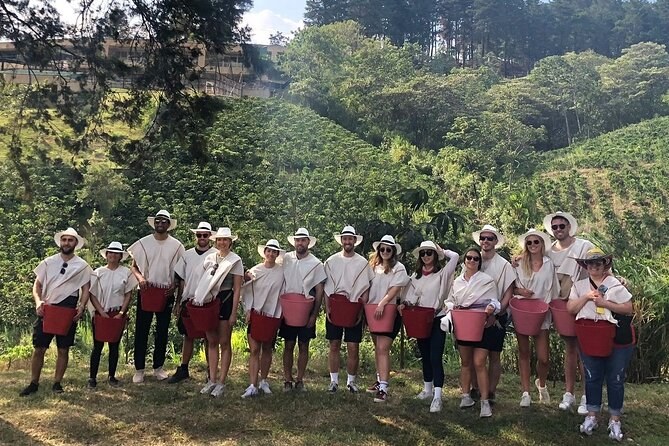
9. The poncho is not a costume, it is workwear
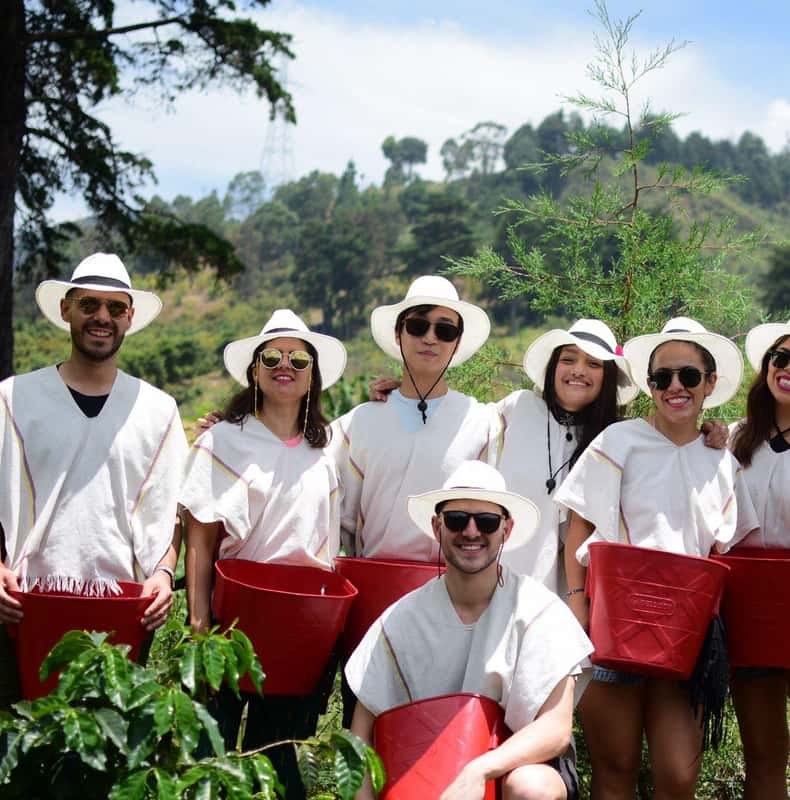
The arriero outfit farms hand out — poncho, hat, woven basket on a belt — is what muleteers actually wore and what pickers still use. The basket is belted at the waist because you need both hands. Four of these farms let you keep the poncho.
10. Coffee flowers smell like jasmine and last two days
The white blossom that covers a plantation after rain is gone within about 48 hours, and the cherry that follows takes seven to nine months to ripen. Catch a farm in flower and it is the one thing on the whole tour nobody photographs enough.
Useful tip. If you want to see picking rather than a demonstration, come in October or November, or in May. The harvest page goes month by month, and every farm runs its full tour year-round either way.
11. The farms sell their own coffee cheaper than the city does
A bag at the gate costs less than the same lot in a specialty café in El Poblado and considerably less than at the airport. Three listings note bagged coffee is not in the fare but is on sale, and it is a cash business. What to expect covers what else to carry.
12. Colombia's coffee is grown almost entirely on small farms
The average Colombian coffee holding is a couple of hectares, worked by a family, and that is exactly what you visit here. There is no plantation in the industrial sense on this sheet: the largest of these fincas would fit inside a single field of a Brazilian estate. It is why the tours feel like being shown round somebody's home, because they are.
13. The arriero is Antioquia's founding character, and coffee is why
Muleteers moved coffee, goods and people over the mountains before there were roads, and the poncho, hat and machete cover the farms hand out are theirs. The whole regional identity that Medellin sells to visitors — paisa, hard-working, mountain — comes out of that trade. The costume is not a gimmick; it is the uniform of the people who built the economy the city grew from.
14. The city's flower festival grows out of the same hillsides
Santa Elena, the corregimiento above the Arví cable, is silletero country: the flower growers who carry huge arrangements down into Medellin every August for the Feria de las Flores. Two of the coffee farms here sit in the same district, on the same slopes, and the drive up passes the flower plots. Things to do covers the festival and when it falls.
Facts by the numbers
| Growers inside Medellin | 200 |
| Of those, in San Sebastián de Palmitas | 120 |
| Antioquia's rank nationally | Second |
| Antioquia hectares planted | 114,312 hectares |
| Colombian crop, 2025 | 13.67 million 60-kilogram sacks |
| Main harvest | September to December |
| Mitaca | March or April to June |
| Medellin elevation | 1,495 metres |
15. Coffee reached Colombia through a priest and a penance
The story told on farms across the country is that a priest in Santander set penances in coffee seedlings rather than prayers, which is how the crop spread through the region in the early nineteenth century. Whether or not the detail survives scrutiny, it is the version every guide here tells, and it is a fair description of how a smallholder crop actually propagates: neighbour to neighbour, a handful at a time.
16. The word "paisa" and the word "arriero" both come off these hills
Paisa is what people from Antioquia and the surrounding departments call themselves, and the arriero — the muleteer who moved coffee over the mountains before the roads — is the figure at the centre of the identity. Every farm that hands you a poncho and a hat is handing you a working uniform rather than a costume. The diploma several of them give you at the end names you an arriero, which is a joke with a real history behind it.
17. A single coffee tree yields about a pound of roasted coffee a year
Roughly five kilograms of cherry becomes one kilogram of green coffee, and roasting takes about another fifteen per cent off in water weight. A mature, well-tended tree gives you somewhere near half a kilo of roasted coffee for a year of its life. Stand in a row and do that arithmetic and the price of a bag at the farm gate starts to look like a bargain rather than a souvenir.
Go and see it
Every fact above is visible on a farm morning, and most of them come up in the first hour. Medellin Coffee Tours lists the days that show you the whole chain, with free cancellation at 24 hours on all of them.
See it on a farm morning
Coffee and Flavors of Antioquia Sightseeing Tour ☕ (Real Farm Experience)
LunchTasting
From $88 per person