Half-Day Coffee Tour: From the Seed to the Cup, Farm & roastery
Max 15Hotel pickup
From $86 per person
Almost every coffee tour running from Medellin is one of two things, and the listings do not make that obvious. One is a half day built around the coffee itself. The other is a full day built around the countryside and a meal. They cost about the same and they are not competing for the same traveller. Here is the difference, and where coffee tour Medellin half day sit on each side of it.
If you came for the coffee, take the half day: the roastery and the cupping table are the parts you cannot get anywhere else. If you came for Colombia, take the full day: the drive, the family kitchen and the fiambre paisa are the parts you will describe when you get home. Both are back in the city the same afternoon.
| Half day | Full day | |
|---|---|---|
| Typical price | $86 | $74–$88 |
| Length | 4 to 5 hours | 5 to 6 hours |
| On the farm | About 3 hours | 3 to 4 hours |
| Lunch | Not included | Fiambre paisa included |
| Roastery | Yes, a commercial micro-roastery | No |
| Cupping table | Yes | A farm tasting instead |
| Group cap | 15 | Up to 70 on some listings |
| Pickup | Free in El Poblado, surcharge elsewhere | Free from four neighbourhoods |
| Back by | About 1pm | 2pm to 3pm |
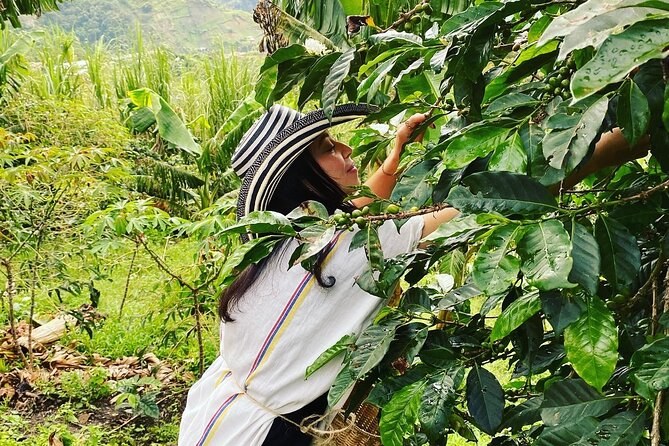
Three hours on an organic plantation and two more in a mill and roastery is the only format here that follows a bean the whole way. You watch a commercial drum roaster work, and you finish on a cupping table with lots that have been scored by professional graders. The group caps at fifteen, which is small enough to ask questions at the roaster.
It also starts at eight and finishes around one, which leaves a genuinely useful afternoon. What it does not include is lunch, and the day is long enough that this matters — eat properly before you go.
Forty-five minutes out to San Sebastián de Palmitas or Ebéjico, an outfit handed to you at the gate, three and a half hours guided through the whole growing and processing side, and then a fiambre paisa served on the balcony of a farmhouse. Several of these add a coffee-husk tea, a mucilage frappé and a poncho you keep.
The tasting is a farm tasting rather than a cupping table, which is a real difference in depth. What you gain instead is the countryside, the family, and a meal travellers talk about as often as the coffee.
It is, on a longer trip, because they genuinely show you different things. Take the countryside day first for the growing side and the meal, then the roastery half day later in the week for the processing and the tasting. Do not book them on consecutive mornings unless you like coffee more than most people.
They are a third option and often the right one. The Comuna 8 farm runs four hours fifteen for $55, never leaves Medellin, includes the metro and tram fares, and puts three hours on a working farm. It has no lunch and no roastery, and for a lot of travellers that is exactly the trade they wanted. The urban coffee tour page covers all four of them.
The two formats land within about ten dollars of each other, which makes the comparison harder rather than easier. What separates them is not quality but content. On the half day you are paying for a second venue: a mill, a commercial roaster and a team who cup for a living, plus a group cap of fifteen. On the full day you are paying for distance and a kitchen: a forty-five minute drive each way, a farm with a household on it, and a cooked meal for everybody.
Put crudely, one buys you expertise and the other buys you hospitality. Neither is better value; they are different purchases. What does change the maths is party size, because the private half-days are quoted per person rather than per vehicle, so a group of four pays four times over. The cost guide sets out every band.
The decision guide takes this further and sets all four shapes of day against each other.
It is not a shortcut. Four to five hours from an 8am start is a full morning, and it covers more ground than the longer format does, because none of it is spent driving. The reason it reads as the smaller option is only that it has no meal in it, and that is worth saying plainly: you finish around one and you will want lunch.
It is also not the cheapest way to see a coffee farm. That is the city farm in Comuna 8, which runs on the metro and comes in below both formats. If price is the deciding factor rather than depth, start there and spend the difference on a bag of coffee at the gate.
It is not a long day. Five to six hours with a 9am pickup puts you back in Medellin between two and three, which leaves an afternoon. The name is misleading and it puts people off who would have enjoyed it.
Nor is it a shallow version of the coffee. The countryside farms cover the whole growing and wet-processing side properly, and one of them pours a honey-process and a cherry-process lot side by side, which is a better tasting lesson than most cafes will give you. What it skips is the industrial half: the mill, the drum roaster and the scored lots.
Both formats are good and they are good at different things, which is the whole point. Medellin Coffee Tours lists every departure with its length, its price and its hours on the farm, and free cancellation at 24 hours means the decision is not final until the day before.
From $86 per person