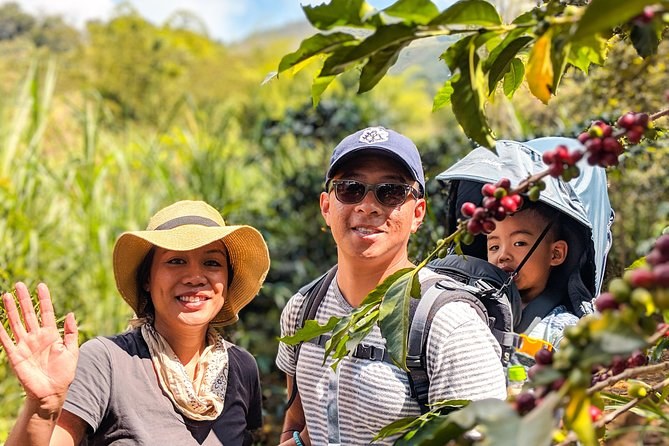
Half-Day Coffee Tour: From the Seed to the Cup, Farm & roastery
Max 15Hotel pickup
From $86 per person
The listings make this look harder than it is. Read them side by side and the same words come back — farm, tasting, transport, lunch — and nothing tells you what actually separates one morning from another. It comes down to four shapes of day, and once you know which one you want the individual product almost picks itself. That is what this guide does, and best coffee tour Medellin are compared throughout.
Every coffee tour running from Medellin is a version of one of these. The differences inside each group are small; the differences between the groups decide your whole morning.
| Shape | Length | Roughly | What it is really for |
|---|---|---|---|
| City farm | 1.5–4.5 hrs | $55–$103 | Half a day, no car, and the cable car ride is part of it |
| Countryside farm | 5–6 hrs | $74–$88 | The full paisa day, a family kitchen and a proper lunch |
| Farm plus roastery | 4–5 hrs | $86 | The coffee itself, through a commercial roaster to a cupping table |
| Private | 4–12 hrs | $104–$299 | Your own car, your own guide and a start time you set |
Answer a handful of questions and the shape falls out. Do you have a car or the patience for public transport? Do you want a meal or do you want depth on the coffee? And is this the only free morning of your trip, or one of several?
No, and this is the fact almost nobody arrives knowing. Medellin has 200 registered coffee growers inside its own boundary, spread across five rural districts that are legally part of the city. One of the farms is in Comuna 8 and you reach it by tram and cable car; two more are above Santa Elena at the top of the Arví cable line.
What you give up by staying in is a full lunch and, in most cases, an hour of farm time. What you gain is a morning that costs less, involves no minibus, and gives you a side of the city that most visitors never see. The urban coffee tour page covers all four of them.
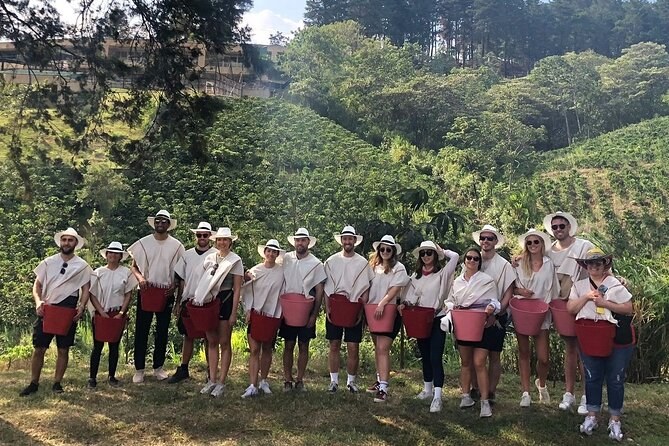
If you want the meal and the household, yes. Forty to sixty minutes each way buys you a working finca with a kitchen in it, a fiambre paisa served at a table, and three to four hours in rows that run further than you can see. Several of these days add a coffee-husk tea, a mucilage frappé, a poncho you keep and a picker's certificate.
If what you want is technical depth, the drive buys you less. The countryside farms cover the growing and wet-processing side thoroughly and stop there. The roastery half day keeps going into milling, roasting and a scored cupping table, and does it in less time overall. The seed-to-cup page sets out what each stage involves.
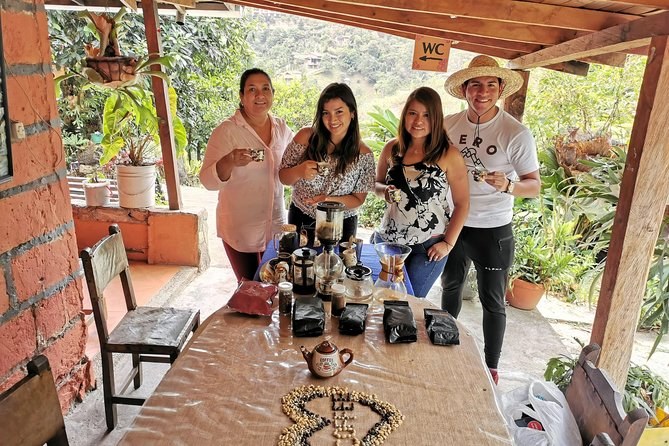
Three things a plantation cannot give you. A commercial drum roaster, which is a different machine from the pan or table-top drum a farm uses. A team who cup for a living and can tell you what a score means. And lots that have actually been graded, so the tasting has numbers attached rather than adjectives.
It is also the only format here that shows you the industrial half of the chain, which is where most of Colombia's coffee actually goes. The tastings page covers the cupping ritual before you get there.
More than the price suggests, and less than the word implies. What you buy is a vehicle and a guide for your own party, a start time you agree rather than accept, and door-to-door collection from four neighbourhoods. What you do not buy is a different farm: the private half-day visits a family finca at Sabaneta and covers the same chain as the shared days.
The maths matters. These fares are quoted per person, not per vehicle, so a party of four pays four times. For couples it is a modest premium; for families it is a real decision. The private tour page sets out what each private option includes.
Most of them, with one caveat: the ground. Coffee grows on a slope, the rows are earth, and a pushchair will not work anywhere here. Children over about six manage it easily and generally enjoy it more than the adults do — there is a basket, a machine to crank and something to drink at the end.
For under-fives, the ninety-minute barista workshop above Parque Arví is the practical choice: short, capped at ten travellers, and the cable car does half the entertaining. Two listings state that infants travel on laps rather than in seats.
It changes what you do rather than which shape works. Antioquia harvests twice — the main crop September to December, peaking through November, and the mitaca March or April to June — and in those windows the basket you are handed genuinely fills. Outside them the picking becomes a demonstration on a few late trees.
Everything else runs identically all year: de-pulping, fermentation, drying, roasting and tasting. If picking matters to you, weight the decision towards a countryside farm in October or November. The harvest page goes month by month.
Most of these run in English or bilingually, and several employ a dedicated translator. One product runs in Spanish only and says so plainly. If English matters, check the language line before you pay: one traveller booked an English day, found it running in Spanish, and made the best of it.
Guides on the better-reviewed products are named again and again by travellers, which is usually a fair signal. The names that come up most often here belong to the roastery half day, the Comuna 8 farm and the private morning from El Poblado.
By price per hour on a farm, the Comuna 8 day at $55: three hours on a working finca plus the tram and cable fares, for less than any other format. By content per dollar, the roastery half day, which is the only one that includes a second venue. By sheer volume of things included, the countryside days, which add a meal, an outfit, a souvenir and often a certificate.
None of those is the same question as "which will I enjoy most", which is the one worth answering. The cost guide breaks every band down line by line.
Ten named fincas sit behind the departures running from the city, and four of them share one corregimiento. That is why so many listings describe the same forty-five minute drive west and the same fiambre paisa: they are neighbours. The farms page names each one and says where it sits.
Does the individual farm matter? Less than the format does. What varies between fincas is the extras — a spa, a horseback ride, a museum, five fruit stations, a roastery — rather than the coffee itself. Pick the shape of day first and treat the farm as the tiebreaker.
They vary more than on most sheets, and the caps are stated rather than implied. The tightest is seven travellers on the Santa Elena spa day; then eight on the small-group Buenos Aires farm, ten on the barista workshop, fifteen on the roastery half day, nineteen on the Comuna 8 farm and twenty on one of the Palmitas days. Two listings state a cap of seventy, which is a coach rather than a minibus.
A cap is a ceiling rather than a forecast, and in practice most of these run smaller. But if a small group is the thing you are buying, book one of the products that states a low number rather than hoping.
Three honest exclusions. Do not book a six-hour countryside day if your youngest child is under five — the drives are the problem, not the farm. Do not book the Comuna 8 farm if steep ground is difficult, because the walk up is unavoidable. And do not book the twelve-hour Jardín day expecting a coffee tour: it is a day trip to a mountain village with a farm visit inside it, and it is excellent as that.
| If this is you | Book | Roughly |
|---|---|---|
| Came for the coffee | The farm-and-roastery half day | $86 |
| Came for Colombia | A countryside farm day with lunch | $74–$88 |
| Half a day and no car | The Comuna 8 city farm | $55 |
| Travelling with small children | The Arví barista workshop | $57 |
| Want it to yourselves | A private half-day | $104 |
| Want a spa afterwards | The Santa Elena coffee and spa day | $103 |
| Have a whole day | The Jardín run | $299 |
Pick the format first and the finca second and you will get the morning you imagined. Medellin Coffee Tours lists every departure with its length, its price and its hours on the farm, and every one of them refunds in full at 24 hours.
From $86 per person
From $104 per person